I haven’t been actively blogging for several years at this point, but have instead been posting on other social media. These days I’m on Bluesky (@njohnston.ca), so here’s my Bluesky feed—come talk to me there:
Category Archives: Uncategorized
Taylor Polynomials from Orthogonal Projections
One of the standard applications of orthogonal projections to function spaces comes in the form of Fourier series, where we use \(B = \{1,\cos(x),\sin(x),\cos(2x),\sin(2x),\ldots\}\) as a mutually orthogonal set of functions with respect to the usual inner product
\(\displaystyle\langle f, g \rangle = \int_{-\pi}^\pi f(x)g(x) \, \mathrm{d}x.\)
In particular, projecting a function onto the span of the first 2n+1 functions in the set \(B\) gives its order-n Fourier approximation:
\(\displaystyle f(x) \approx a_0 + \sum_{k=1}^n a_k \cos(kx) + \sum_{k=1}^n b_k \sin(kx),\)
where the coefficients \(a_0,a_1,a_2,\ldots,a_n\) and \(b_1,b_2,\ldots,b_n\) can be computed via inner products (i.e., integrals) in this space (see many other places on the web, like here and here, for more details).
A natural follow-up question is then whether or not we similarly get Taylor polynomials when we project a function down onto the span of the set of functions \(C = \{1,x,x^2,x^3,\ldots,x^n\}\). More specifically, if we define \(\mathcal{C}[-1,1]\) to be the inner product space consisting of continuous functions on the interval [-1,1] with the standard inner product
\(\displaystyle\langle f, g \rangle = \int_{-1}^1 f(x)g(x) \, \mathrm{d}x,\)
and consider the orthogonal projection \(P : \mathcal{C}[-1,1] \rightarrow \mathcal{C}[-1,1]\) with range equal to \(\mathcal{P}_n[-1,1]\), the subspace of degree-n polynomials, is it the case that \(P(e^x)\) is the degree-n Taylor polynomial of \(e^x\)?
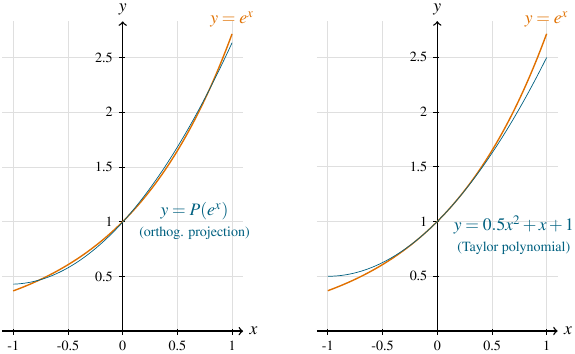
It does not take long to work through an example to see that, no, we do not get Taylor polynomials when we do this. For example, if we choose n = 2 then projecting the function \(e^x\) onto the \(\mathcal{P}_2[-1,1]\) results in the function \(P(e^x) \approx 0.5367x^2 + 1.1036x + 0.9963\), which is not its degree-2 Taylor polynomial \(p_2(x) = 0.5x^2 + x + 1\). These various functions are plotted below (\(e^x\) is displayed in orange, and the two different approximating polynomials are displayed in blue):

These plots illustrate why the orthogonal projection of \(e^x\) does not equal its Taylor polynomial: the orthogonal projection is designed to approximate \(e^x\) as well as possible on the whole interval [-1,1], whereas the Taylor polynomial is designed to approximate it as well as possible at x = 0 (while sacrificing precision near the endpoints of the interval, if necessary).
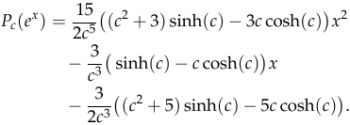
However, something interesting happens if we change the interval that the orthogonal projection acts on. In particular, if we let \(0 < c \in \mathbb{R}\) be a scalar and instead consider the orthogonal projection \(P_c : \mathcal{C}[-c,c] \rightarrow \mathcal{C}[-c,c]\) with range equal to \(\mathcal{P}_2[-c,c]\), then a straightforward (but hideous) calculation shows that the best degree-2 polynomial approximation of \(e^x\) on the interval [-c,c] is

While this by itself is an ugly mess, something interesting happens if we take the limit as c approaches 0:
\(\displaystyle\lim_{c\rightarrow 0^+} P_c(e^x) = \frac{1}{2}x^2 + x + 1,\)
which is exactly the Taylor polynomial of \(e^x\). Intuitively, this makes sense and meshes with our earlier observations about Taylor polynomials approximating \(e^x\) at x = 0 as well as possible and orthogonal projections \(P_c(e^x)\) approximating \(e^x\) as well as possible on the interval \([-c,c]\). However, I am not aware of any proof that this happens in general (i.e., no matter what the degree of the polynomial is and no matter what (sufficiently nice) function is used in place of \(e^x\)), and I would love for a kind-hearted commenter to point me to a reference. [Update: user “jam11249” provided a sketch proof of this fact on reddit here.]
Here is an interactive Desmos plot that you can play around with to see the orthogonal projection approach the Taylor polynomial as \(c \rightarrow 0\).
How to compute hard-to-compute matrix norms
There are a wide variety of different norms of matrices and operators that are useful in many different contexts. Some matrix norms, such as the Schatten norms and Ky Fan norms, are easy to compute thanks to the singular value decomposition. However, the computation of many other norms, such as the induced p-norms (when p ≠ 1, 2, ∞), is NP-hard. In this post, we will look at a general method for getting quite good estimates of almost any matrix norm.
The basic idea is that every norm can be written as a maximization of a convex function over a convex set (in particular, every norm can be written as a maximization over the unit ball of the dual norm). However, this maximization is often difficult to deal with or solve analytically, so instead it can help to write the norm as a maximization over two or more simpler sets, each of which can be solved individually. To illustrate how this works, let’s start with the induced matrix norms.
Induced matrix norms
The induced p → q norm of a matrix B is defined as follows:
\(\displaystyle\|B\|_{p\rightarrow q}:=\max\big\{\|B\mathbf{x}\|_q : \|\mathbf{x}\|_p = 1\big\},\)
where
\(\displaystyle\|\mathbf{x}\|_p := \left(\sum_{i}|x_i|^p\right)^{1/p}\)
is the vector p-norm. There are three special cases of these norms that are easy to compute:
- When p = q = 2, this is the usual operator norm of B (i.e., its largest singular value).
- When p = q = 1, this is the maximum absolute column sum: \(\|B\|_{1\rightarrow 1} = \max_j\sum_i|b_{ij}|\).
- When p = q = ∞, this is the maximum absolute row sum: \(\|B\|_{\infty\rightarrow \infty} = \max_i\sum_j|b_{ij}|\).

However, outside of these three special cases (and some other special cases, such as when B only has real entries that are non-negative [1]), this norm is much messier. In general, its computation is NP-hard [2], so how can we get a good idea of its value? Well, we rewrite the norm as the following double maximization:
\(\displaystyle\|B\|_{p\rightarrow q}=\max\big\{|\mathbf{y}^*B\mathbf{x}| : \|\mathbf{x}\|_p = 1, \|\mathbf{y}\|_{q^\prime} = 1\big\},\)
where \(q^\prime\) is the positive real number such that \(1/q + 1/q^\prime = 1\) (and we take \(q^\prime = 1\) if \(q = \infty\), and vice-versa). The idea is then to maximize over \(\mathbf{x}\) and \(\mathbf{y}\) one at a time, alternately.
- Start by setting \(j = 1\) and fixing a randomly-chosen vector \(\mathbf{x}_0\), scaled so that \(\|\mathbf{x}_0\|_{p} = 1\).
- Compute
\(\max\big\{|\mathbf{y}^*B\mathbf{x}_{j-1}| : \|\mathbf{y}\|_{q^\prime} = 1\big\},\)
keeping \(\mathbf{x}_{j-1}\) fixed, and let \(\mathbf{y}_j\) be the vector attaining this maximum. By Hölder’s inequality, we know that this maximum value is exactly equal to \(\|B\mathbf{x}_{j-1}\|_{q}\). Furthermore, the equality condition of Hölder’s inequality tells us that the vector \(\mathbf{y}_j\) attaining this maximum is the one with complex phases that are the same as those of \(B\mathbf{x}_{j-1}\), and whose magnitudes are such that \(|\mathbf{y}_j|^{q^\prime}\) is a multiple of \(|B\mathbf{x}_{j-1}|^q\) (here the notation \(|\cdot|^q\) means we take the absolute value and the q-th power of every entry of the vector).
- Compute
\(\max\big\{|\mathbf{y}_j^*B\mathbf{x}| : \|\mathbf{x}\|_{p} = 1\big\},\)
keeping \(\mathbf{y}_j\) fixed, and let \(\mathbf{x}_j\) be the vector attaining this maximum. By an argument almost identical to that of step 2, this maximum is equal to \(\|B^*\mathbf{y}_j\|_{p^\prime}\), where \(p^\prime\) is the positive real number such that \(1/p + 1/p^\prime = 1\). Furthermore, the vector \(\mathbf{x}_j\) attaining this maximum is the one with complex phases that are the same as those of \(B^*\mathbf{y}_j\), and whose magnitudes are such that \(|\mathbf{x}_j|^p\) is a multiple of \(|B^*\mathbf{y}_j|^{p^\prime}\).
- Increment \(j\) by 1 and return to step 2. Repeat until negligible gains are made after each iteration.
This algorithm is extremely quick to run, since Hölder’s inequality tells us exactly how to solve each of the two maximizations separately, so we’re left only performing simple vector calculations at each step. The downside of this algorithm is that, even though it will always converge to some local maximum, it might converge to a value that is smaller than the true induced p → q norm. However, in practice this algorithm is fast enough that it can be run several thousand times with different (randomly-chosen) starting vectors \(\mathbf{x}_0\) to get an extremely good idea of the value of \(\|B\|_{p\rightarrow q}\).
It is worth noting that this algorithm is essentially the same as the one presented in [3], and reduces to the power method for finding the largest singular value when p = q = 2. This algorithm has been implemented in the QETLAB package for MATLAB as the InducedMatrixNorm function.
Induced Schatten superoperator norms
There is a natural family of induced norms on superoperators (i.e., linear maps \(\Phi : M_n \rightarrow M_n\)) as well. First, for a matrix \(X \in M_n\), we define its Schatten p-norm to be the p-norm of its vector of singular values:
\(\|X\|_p := \left(\sum_{i=1}^n \sigma_i(X)^p\right)^{1/p}.\)
Three special cases of the Schatten p-norms include:
- p = 1, which is often called the “trace norm” or “nuclear norm”,
- p = 2, which is often called the “Frobenius norm” or “Hilbert–Schmidt norm”, and
- p = ∞, which is the usual operator norm.
The Schatten norms themselves are easy to compute (since singular values are easy to compute), but their induced counter-parts are not.
Given a superoperator \(\Phi : M_n \rightarrow M_n\), its induced Schatten p → q norm is defined as follows:
\(\|\Phi\|_{p\rightarrow q} := \max\big\{ \|\Phi(X)\|_q : \|X\|_p = 1 \big\}.\)
These induced Schatten norms were studied in some depth in [4], and crop up fairly frequently in quantum information theory (especially when p = q = 1) and operator theory (especially when p = q = ∞). The fact that they are NP-hard to compute in general is not surprising, since they reduce to the induced matrix norms (discussed earlier) in the case when \(\Phi\) only acts on the diagonal entries of \(X\) and just zeros out the off-diagonal entries. However, it seems likely that this norm’s computation is also difficult even in the special cases p = q = 1 and p = q = ∞ (however, it is straightforward to compute when p = q = 2).
Nevertheless, we can obtain good estimates of this norm’s value numerically using essentially the same method as discussed in the previous section. We start by rewriting the norm as a double maximization, where each maximization individually is easy to deal with:
\(\|\Phi\|_{p\rightarrow q} = \max\big\{ |\mathrm{Tr}(Y^*\Phi(X))| : \|X\|_p = 1, \|Y\|_{q^\prime} = 1\big\},\)
where \(q^\prime\) is again the positive real number (or infinity) satisfying \(1/q + 1/q^\prime = 1\). We now maximize over \(X\) and \(Y\), one at a time, alternately, just as before:
- Start by setting \(j = 1\) and fixing a randomly-chosen matrix \(X_0\), scaled so that \(\|X_0\|_p = 1\).
- Compute
\(\max\big\{|\mathrm{Tr}(Y^*\Phi(X_{j-1})| : \|Y\|_{q^\prime} = 1\big\},\)
keeping \(X_{j-1}\) fixed, and let \(Y_j\) be the matrix attaining this maximum. By the Hölder inequality for Schatten norms, we know that this maximum value is exactly equal to \(\|\Phi(X_{j-1})\|_{q}\). Furthermore, the matrix \(Y_j\) attaining this maximum is the one with the same left and right singular vectors as \(\Phi(X_{j-1})\), and whose singular values are such that there is a constant \(c\) so that \(\sigma_i(Y_j)^{q^\prime} = c\sigma_i(\Phi(X_{j-1}))^q\) for all \(i\) (i.e., the vector of singular values of \(Y_j\), raised to the \(q^\prime\) power, is a multiple of the vector of singular values of \(\Phi(X_{j-1})\), raised to the \(q\) power).
- Compute
\(\max\big\{|\mathrm{Tr}(Y_j^*\Phi(X)| : \|X\|_{p} = 1\big\},\)
keeping \(Y_j\) fixed, and let \(X_j\) be the matrix attaining this maximum. By essentially the same argument as in step 2, we know that this maximum value is exactly equal to \(\|\Phi^*(Y_j)\|_{p^\prime}\), where \(\Phi^*\) is the map that is dual to \(\Phi\) in the Hilbert–Schmidt inner product. Furthermore, the matrix \(X_j\) attaining this maximum is the one with the same left and right singular vectors as \(\Phi^*(Y_j)\), and whose singular values are such that there is a constant \(c\) so that \(\sigma_i(X_j)^{p} = c\sigma_i(\Phi^*(Y_j))^{p^\prime}\) for all \(i\).
- Increment \(j\) by 1 and return to step 2. Repeat until negligible gains are made after each iteration.
The above algorithm is almost identical to the algorithm presented for induced matrix norms, but with absolute values and complex phases of the vectors \(\mathbf{x}\) and \(\mathbf{y}\) replaced by the singular values and singular vectors of the matrices \(X\) and \(Y\), respectively. The entire algorithm is still extremely quick to run, since each step just involves computing one singular value decomposition.
The downside of this algorithm, as with the induced matrix norm algorithm, is that we have no guarantee that this method will actually converge to the induced Schatten p → q norm; only that it will converge to some lower bound of it. However, the algorithm works pretty well in practice, and is fast enough that we can simply run it a few thousand times to get a very good idea of what the norm actually is. If you’re interested in making use of this algorithm, it has been implemented in QETLAB as the InducedSchattenNorm function.
Entanglement Norms
The central idea used for the previous two families of norms can also be used to get lower bounds on the following norm on \(M_m \otimes M_n\) that comes up from time to time when dealing with quantum entanglement:
\(\|X\|_{S(1)} := \max\Big\{\big|(\mathbf{v}\otimes\mathbf{w})^*X(\mathbf{x} \otimes \mathbf{y})\big| : \|\mathbf{v}\| = \|\mathbf{w}\| = \|\mathbf{x}\| = \|\mathbf{y}\| = 1\Big\}.\)
(As a side note: this norm, and some other ones like it, were the central focus on my thesis.) This norm is already written for us as a double maximization, so the idea presented in the previous two sections is somewhat clearer from the start: we fix randomly-generated vectors \(\mathbf{v}\) and \(\mathbf{x}\) and then maximize over all vectors \(\mathbf{w}\) and \(\mathbf{y}\), which can be done simply by computing the left and right singular vectors associated with the maximum singular value of the operator
\((\mathbf{v} \otimes I)^*X(\mathbf{x} \otimes I) \in M_n.\)
We then fix \(\mathbf{w}\) and \(\mathbf{y}\) as those singular vectors and then maximize over all vectors \(\mathbf{v}\) and \(\mathbf{x}\) (which is again a singular value problem), and we iterate back and forth until we converge to some value.
As with the previously-discussed norms, this algorithm always converges, and it converges to a lower bound of \(\|X\|_{S(1)}\), but perhaps not its exact value. If you want to take this algorithm out for a spin, it has been implemented in QETLAB as the sk_iterate function.
It’s also worth mentioning that this algorithm generalizes straightforwardly in several different directions. For example, it can be used to find lower bounds on the norms \(\|\cdot\|_{S(k)}\) where we maximize on the left and right by pure states with Schmidt rank not larger than k rather than separable pure states, and it can be used to find lower bounds on the geometric measure of entanglement [5].
References:
- D. Steinberg. Computation of matrix norms with applications to robust optimization. Research thesis. Technion – Israel University of Technology, 2005.
- J. M. Hendrickx and A. Olshevsky. Matrix p-norms are NP-hard to approximate if p ≠ 1,2,∞. 2009. E-print: arXiv:0908.1397
- D. W. Boyd. The power method for ℓp norms. Linear Algebra and Its Applications, 9:95–101, 1974.
- J. Watrous. Notes on super-operator norms induced by Schatten norms. Quantum Information & Computation, 5(1):58–68, 2005. E-print: arXiv:quant-ph/0411077
- T.-C. Wei and P. M. Goldbart. Geometric measure of entanglement and applications to bipartite and multipartite quantum states. Physical Review A, 68:042307, 2003. E-print: arXiv:quant-ph/0212030

Introducing QETLAB: A MATLAB toolbox for quantum entanglement
After over two and a half years in various stages of development, I am happy to somewhat “officially” announce a MATLAB package that I have been developing: QETLAB (Quantum Entanglement Theory LABoratory). This announcement is completely arbitrary, since people started finding QETLAB via Google about a year ago, and a handful of papers have made use of it already, but I figured that I should at least acknowledge its existence myself at some point. I’ll no doubt be writing some posts in the near future that highlight some of its more advanced features, but I will give a brief run-down of what it’s about here.
The Basics
First off, QETLAB has a variety of functions for dealing with “simple” things like tensor products, Schmidt decompositions, random pure and mixed states, applying superoperators to quantum states, computing Choi matrices and Kraus operators, and so on, which are fairly standard daily tasks for quantum information theorists. These sorts of functions are somewhat standard, and are also found in a few other MATLAB packages (such as Toby Cubitt’s nice Quantinf package and Géza Tóth’s QUBIT4MATLAB package), so I won’t really spend any time discussing them here.
Mixed State Separability
The “motivating problem” for QETLAB is the separability problem, which asks us to (efficiently / operationally / practically) determine whether a given mixed quantum state is separable or entangled. The (by far) most well-known tool for this job is the positive partial transpose (PPT) criterion, which says that every separable state remains positive semidefinite when the partial transpose map is applied to it. However, this is just a quick-and-dirty one-way test, and going beyond it is much more difficult.
The QETLAB function that tries to solve this problem is the IsSeparable function, which goes through several separability criteria in an attempt to prove the given state separable or entangled, and provides a journal reference to the paper that contains the separability criteria that works (if one was found).
As an example, consider the “tiles” state, introduced in [1], which is an example of a quantum state that is entangled, but is not detected by the simple PPT test for entanglement. We can construct this state using QETLAB’s UPB function, which lets the user easily construct a wide variety of unextendible product bases, and then verify its entanglement as follows:
>> u = UPB('Tiles'); % generates the "Tiles" UPB >> rho = eye(9) - u*u'; % rho is the projection onto the orthogonal complement of the UPB >> rho = rho/trace(rho); % we are now done constructing the bound entangled state >> IsSeparable(rho) Determined to be entangled via the realignment criterion. Reference: K. Chen and L.-A. Wu. A matrix realignment method for recognizing entanglement. Quantum Inf. Comput., 3:193-202, 2003. ans = 0
And of course more advanced tests for entanglement, such as those based on symmetric extensions, are also checked. Generally, quick and easy tests are done first, and slow but powerful tests are only performed if the script has difficulty finding an answer.
Alternatively, if you want to check individual tests for entanglement yourself, you can do that too, as there are stand-alone functions for the partial transpose, the realignment criterion, the Choi map (a specific positive map in 3-dimensional systems), symmetric extensions, and so on.
Symmetry of Subsystems
One problem that I’ve come across repeatedly in my work is the need for robust functions relating to permuting quantum systems that have been tensored together, and dealing with the symmetric and antisymmetric subspaces (and indeed, this type of thing is quite common in quantum information theory). Some very basic functionality of this type has been provided in other MATLAB packages, but it has never been as comprehensive as I would have liked. For example, QUBIT4MATLAB has a function that is capable of computing the symmetric projection on two systems, or on an arbitrary number of 2- or 3-dimensional systems, but not on an arbitrary number of systems of any dimension. QETLAB’s SymmetricProjection function fills this gap.
Similarly, there are functions for computing the antisymmetric projection, for permuting different subsystems, and for constructing the unitary swap operator that implements this permutation.
Nonlocality and Bell Inequalities
QETLAB also has a set of functions for dealing with quantum non-locality and Bell inequalities. For example, consider the CHSH inequality, which says that if \(\{A_1,A_2\}\) and \(\{B_1,B_2\}\) are \(\{-1,+1\}\)-valued measurement settings, then the following inequality holds in classical physics (where \(\langle \cdot \rangle\) denotes expectation):
\(\langle A_1B_1 \rangle + \langle A_1B_2 \rangle + \langle A_2B_1 \rangle – \langle A_2B_2 \rangle \leq 2.\)
However, in quantum-mechanical settings, this inequality can be violated, and the quantity on the left can take on a value as large as \(2\sqrt{2}\) (this is Tsirelson’s bound). Finally, in no-signalling theories, the quantity on the left can take on a value as large as \(4\).
All three of these quantities can be easily computed in QETLAB via the BellInequalityMax function:
>> coeffs = [1 1;1 -1]; % coefficients of the terms <A_iB_j> in the Bell inequality >> a_coe = [0 0]; % coefficients of <A_i> in the Bell inequality >> b_coe = [0 0]; % coefficients of <B_i> in the Bell inequality >> a_val = [-1 1]; % values of the A_i measurements >> b_val = [-1 1]; % values of the B_i measurements >> BellInequalityMax(coeffs, a_coe, b_coe, a_val, b_val, 'classical') ans = 2 >> BellInequalityMax(coeffs, a_coe, b_coe, a_val, b_val, 'quantum') ans = 2.8284 >> BellInequalityMax(coeffs, a_coe, b_coe, a_val, b_val, 'nosignal') ans = 4.0000
The classical value of the Bell inequality is computed simply by brute force, and the no-signalling value is computed via a linear program. However, no reasonably efficient method is known for computing the quantum value of a Bell inequality, so this quantity is estimated using the NPA hierarchy [2]. Advanced users who want more control can specify which level of the NPA hierarchy to use, or even call the NPAHierarchy function directly themselves. There is also a closely-related function for computing the classical, quantum, or no-signalling value of a nonlocal game (in case you’re a computer scientist instead of a physicist).
Download and Documentation
QETLAB v0.8 is currently available at qetlab.com (where you will also find its documentation) and also on github. If you have any suggestions/comments/requests/anything, or if you have used QETLAB in your work, please let me know!
References:
- C.H. Bennett, D.P. DiVincenzo, T. Mor, P.W. Shor, J.A. Smolin, and B.M. Terhal. Unextendible product bases and bound entanglement. Phys. Rev. Lett. 82, 5385–5388, 1999. E-print: arXiv:quant-ph/9808030
- M. Navascués, S. Pironio, and A. Acín. A convergent hierarchy of semidefinite programs characterizing the set of quantum correlations. New J. Phys., 10:073013, 2008. E-print: arXiv:0803.4290 [quant-ph]
“Obvious” Does Not Imply “True”: The Minimal Superpermutation Conjecture is False
One of my favourite examples of an “obvious” mathematical statement that is actually false is the “fact” that if \(R,S,T \subseteq \mathbb{R}^n\) are vector spaces then
\(\dim(R + S + T) = \dim(R) + \dim(S) + \dim(T) \\ {}_{{}_{{}_{.}}}\quad\quad\quad\quad\quad\quad\quad\quad – \dim(R\cap S) -\dim(R\cap T) -\dim(S\cap T) \\ {}_{{}_{{}_{.}}}\quad\quad\quad\quad\quad\quad\quad\quad+\dim(R\cap S\cap T).\)
The reason that the above statement seems so obvious is that the similar fact \(\dim(R + S) = \dim(R) + \dim(S) – \dim(R\cap S)\) does hold, so it’s very tempting to think “inclusion-exclusion, yadda yadda, it’s simple enough to prove that it’s not worth writing down or working through the details”. However, it’s not true: a counterexample is provided by 3 distinct lines through the origin in \(\mathbb{R}^2\).
There is another problem that I’ve been thinking about for quite some time that is also “obvious”: the minimal superpermutation conjecture. This conjecture was so obvious, in fact, that it appeared as a question in a national programming contest in 1998. Well, last night Robin Houston posted a note on the arXiv showing that, despite being obvious, the conjecture is false [1].
Superpermutations
What is the shortest string that contains each permutation of “123” as a contiguous substring? It is straightforward to check that “123121321” contains each of “123”, “132”, “213”, “231”, “312”, and “321” as substrings (i.e., it is a superpermutation of 3 symbols), and it’s not difficult to argue (or use a computer search to show) that it is the shortest string with this property.
Well, we can repeat this question for any number of symbols. I won’t repeat all of the details (because I already wrote about the problem here), but there is a natural recursive construction that takes an (n-1)-symbol superpermutation of length L and spits out an n-symbol superpermutation of length L+n!. This immediately gives us an n-symbol superpermutation of length 1! + 2! + 3! + … + n! for all n. Importantly, it seemed like this construction was the best we could do: computer search verifies that these superpermutations are the smallest possible, and are even unique, for n ≤ 4.
Furthermore, it is not difficult to come up with some lower bounds on the length of superpermutations that seem to suggest that we have found the right answer. A trivial argument shows that an n-symbol superpermutation must have length at least (n-1) + n!, since we need n characters for the first permutation, and 1 additional character for each of the remaining n!-1 permutations. This argument can be refined to show that a superpermutation must actually have length at least (n-2) + (n-1)! + n!, since there is no way to pack the permutations tightly enough so that each one only uses 1 additional character (spend a few minutes trying to construct superpermutations by hand and you’ll see this for yourself). In fact, we can even refine this argument further (see a not-so-pretty proof sketch here) to show that n-symbol superpermutations must have length at least (n-3) + (n-2)! + (n-1)! + n!.
A-ha! A pattern has emerged – surely we can just keep refining this argument over and over again to eventually get a lower bound of 1! + 2! + 3! + … + n!, which shows that the superpermutations we already have are indeed minimal, right? Some variant of this line of thought seemed to be where almost everyone’s mind went when introduced to this problem, and it seemed fairly convincing: this argument is more or less contained within the answers when this question was posted on MathExchange and on StackOverflow (although the authors are usually careful to state that their method only appears to be optimal), and this problem was presented as a programming question in the 1998 Turkish Informatics Olympiad (see the resulting thread here). Furthermore, even on pages where this was acknowledged to be a difficult open problem, it was sometimes claimed that it had been proved for n ≤ 11 (example).
For the above reasons, it was a long time before I was even convinced that this problem was indeed unsolved – it seemed like people had solved this problem but just found it not worth the effort of writing up a full proof, or that people had found a simple way to tackle the problem for moderately large values of n like 10 or 11 that I couldn’t even dream of handling.
The Conjecture is False
It turns out that the minimal superpermutation conjecture is false for all n ≥ 6. That is, there exists a superpermutation of length strictly less than 1! + 2! + 3! + … + n! in all of these cases [1]. In particular, Robin Houston found the following 6-symbol superpermutation of length 872, which is smaller than the conjectured minimum length of 1! + 2! + … + 6! = 873:
12345612345162345126345123645132645136245136425136452136451234651234156234152634 15236415234615234165234125634125364125346125341625341265341235641235461235416235 41263541236541326543126453162435162431562431652431625431624531642531462531426531 42563142536142531645231465231456231452631452361452316453216453126435126431526431 25643215642315462315426315423615423165423156421356421536241536214536215436215346 21354621345621346521346251346215364215634216534216354216345216342516342156432516 43256143256413256431265432165432615342613542613452613425613426513426153246513246 53124635124631524631254632154632514632541632546132546312456321456324156324516324 56132456312465321465324165324615326415326145326154326514362514365214356214352614 35216435214635214365124361524361254361245361243561243651423561423516423514623514 263514236514326541362541365241356241352641352461352416352413654213654123
So not only are congratulations due to Robin for settling the conjecture, but a big “thank you” are due to him as well for (hopefully) convincing everyone that this problem is not as easy as it appears upon first glance.
References
- R. Houston. Tackling the Minimal Superpermutation Problem. E-print: arXiv:1408.5108 [math.CO], 2014.
All Minimal Superpermutations on Five Symbols Have Been Found
Recall from an earlier blog post that the minimal superpermutation problem asks for the shortest string on the symbols “1”, “2”, …, “n” that contains every permutation of those symbols as a contiguous substring. For example, “121” is a minimal superpermutation on the symbols “1” and “2”, since it contains both “12” and “21” as substrings, and there is no shorter string with this property.
Until now, the length of minimal superpermutations has only been known when n ≤ 4: they have length 1, 3, 9, and 33 in these cases, respectively. It has been conjectured that minimal superpermutations have length \(\sum_{k=1}^n k!\) for all n, and I am happy to announce that Ben Chaffin has proved this conjecture when n = 5. More specifically, he showed that minimal superpermutations in the n = 5 case have length 153, and there are exactly 8 such superpermutations (previously, it was only known that minimal superpermutations have either length 152 or 153 in this case, and there are at least 2 superpermutations of length 153).
The Eight Minimal Superpermutations
The eight superpermutations that Ben found are available here (they’re too large to include in the body of this post). Notice that the first superpermutation is the well-known “easy-to-construct” superpermutation described here, and the second superpermutation is the one that was found in [1]. The other six superpermutations are new.
One really interesting thing about the six new superpermutations is that they are the first known minimal superpermutations to break the “gap pattern” that previously-known constructions have. To explain what I mean by this, consider the minimal superpermutation “123121321” on three symbols. We can think about generating this superpermutation greedily: we start with “123”, then we append the character “1” to add the permutation “231” to the string, and then we append the character “2” to add the permutation “312” to the string. But now we are stuck: we have “12312”, and there is no way to append just one character to this string in such a way as to add another permutation to it: we have to append the two characters “13” to get the new permutation “213”.
This phenomenon seemed to be fairly general: in all known small superpermutations on n symbols, there was always a point (approximately halfway through the superpermutation) where n-2 consecutive characters were “wasted”: they did not add any new permutations themselves, but only “prepared” the next symbol to add a new permutation.
However, none of the six new minimal superpermutations have this property: they all never have more than 2 consecutive “wasted” characters, whereas the two previously-known superpermutations each have a run of n-2 = 3 consecutive “wasted” characters. Thus these six new superpermutations are really quite different from any superpermutations that we currently know and love.
How They Were Found
The idea of Ben’s search is to do a depth-first search on the placement of the “wasted” characters (recall that “wasted” characters were defined and discussed in the previous section). Since the shortest known superpermutation on 5 symbols has length 153, and there are 120 permutations of 5 symbols, and the first n-1 = 4 characters of the superpermutation must be wasted, we are left with the problem of trying to place 153 – 120 – 4 = 29 wasted characters. If we can find a superpermutation with only 28 wasted characters (other than the initial 4), then we’ve found a superpermutation of length 152; if we really need all 29 wasted characters, then minimal superpermutations have length 153.
So now we do the depth-first search:
- Find (via brute-force) the maximum number of permutations that we can fit in a string if we are allowed only 1 wasted character: the answer is 10 permutations (for example, the string “123451234152341” does the job).
- Now find the maximum number of permutations that we can fit in a string if we are allowed 2 wasted characters. To speed up the search, once we have found a string that contains some number (call it p) of permutations, we can ignore all other strings that use a wasted character before p-10 permutations, since we know from the previous bullet point that the second wasted character can add at most 10 more permutations, for a total of (p-10)+10 = p permutations.
- We now repeat this process for higher and higher numbers of wasted characters: we find the maximum number of permutations that we can fit in a string with 3 wasted characters, using the results from the previous two bullets to speed up the search by ignoring strings that place 1 or 2 wasted characters too early.
- Etc.
The results of this computation are summarized in the following table:
| Wasted characters | Maximum # of permutations |
|---|---|
| 0 | 5 |
| 1 | 10 |
| 2 | 15 |
| 3 | 20 |
| 4 | 23 |
| 5 | 28 |
| 6 | 33 |
| 7 | 36 |
| 8 | 41 |
| 9 | 46 |
| 10 | 49 |
| 11 | 53 |
| 12 | 58 |
| 13 | 62 |
| 14 | 66 |
| 15 | 70 |
| 16 | 74 |
| 17 | 79 |
| 18 | 83 |
| 19 | 87 |
| 20 | 92 |
| 21 | 96 |
| 22 | 99 |
| 23 | 103 |
| 24 | 107 |
| 25 | 111 |
| 26 | 114 |
| 27 | 116 |
| 28 | 118 |
| 29 | 120 |
As we can see, it is not possible to place all 120 permutations in a string with 28 or fewer wasted characters, which proves that there is no superpermutation of length 152 in the n = 5 case. C code that computes the values in the above table is available here.
Update [August 18, 2014]: Robin Houston has found a superpermutation on 6 symbols of length 873 (i.e., the conjectured minimal length) with the interesting property that it never has more than one consecutive wasted character! The superpermutation is available here.
IMPORTANT UPDATE [August 22, 2014]: Robin Houston has gone one step further and disproved the minimal superpermutation conjecture for all n ≥ 6. See here.
References
- N. Johnston. Non-uniqueness of minimal superpermutations. Discrete Mathematics, 313:1553–1557, 2013.